
ROI in sole manufacturing is not determined by sales alone. Machine performance, downtime, power consumption, production efficiency, and after-sales support all influence long-term profitability.
Many manufacturers focus only on leads, pricing, and closing sales. But the real question is whether the production system can support that growth.
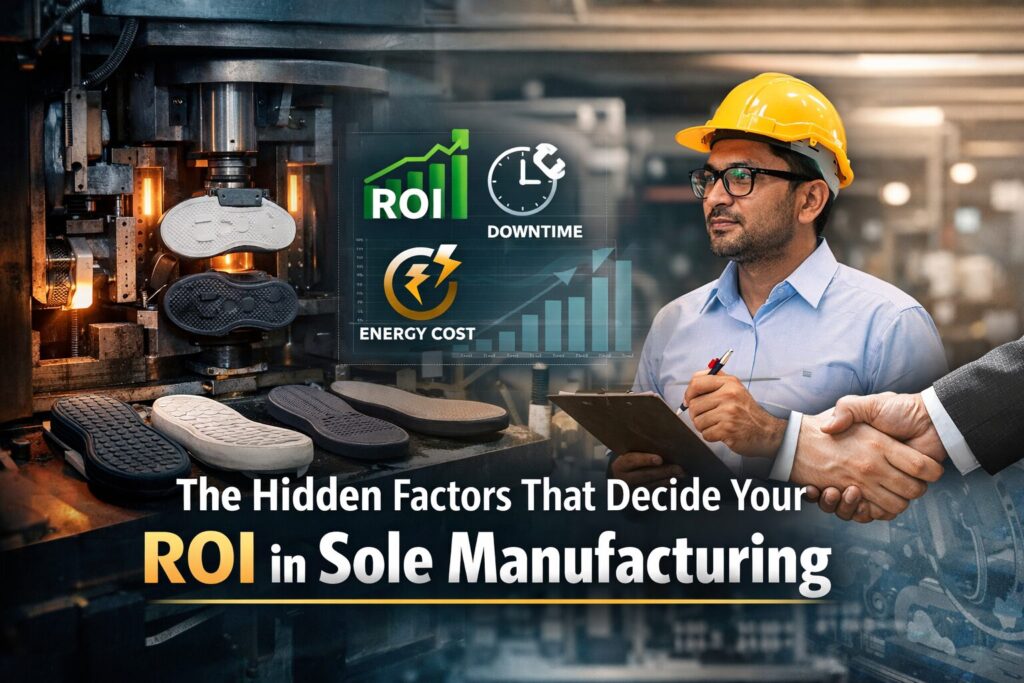
Why ROI Is Not Just About Sales
In sole manufacturing, sales and production are closely connected. A strong sales pipeline cannot deliver consistent profit if the factory setup is unstable.
Before trying to improve conversion rates, every manufacturer should check whether:
- production is stable
- quality is consistent
- cost per pair is under control
- machine downtime is predictable
A weak backend creates bottlenecks that can damage margins even when sales are growing.
The Real ROI Formula for Sole Manufacturers
Many buyers calculate ROI in a very basic way:
Machine Cost ÷ Monthly Profit Increase
That calculation is incomplete.
A machine’s real ROI depends on several operational factors, including:
- machine life
- power consumption
- scrap percentage
- breakdown frequency
- service response
- operator training
A low-cost machine can become expensive if it consumes more electricity, breaks down often, or lacks proper support. Long-term profitability depends on total operating cost, not just purchase price.
What to Check Before Buying a Sole Making Machine
When selecting a sole making machine, price should not be the first factor. A better approach is to evaluate the supplier and the machine on business and technical criteria.
Company Background
Check:
- years in business
- industry experience
- specialization in footwear machinery
A supplier with deep category experience is usually a lower-risk choice than a general machinery seller.
Installed Base
Check:
- number of machines already running in the market
- repeat customers
- large manufacturers using the equipment
A strong installed base usually indicates reliability and market confidence.
After-Sales Service
Check:
- service engineer availability
- response time
- operator training
- preventive maintenance support
After-sales support is directly linked to machine uptime and production continuity.
Technical Components
Verify:
- motor brand
- PLC system
- hydraulic components
- oil tank capacity
- clamping stability
- temperature control system
These components affect:
- power consumption
- machine life
- production consistency
How the Right Machine Strengthens Sales
A well-designed machine does more than improve output. It also makes your sales process easier.
If your machine:
- consumes less electricity
- maintains stable temperature
- produces consistent soles
- minimizes wastage
- runs with fewer breakdowns
then your business gains more pricing stability, better delivery confidence, and stronger production planning. That improves sales trust and reduces execution risk.
How to Handle Cold, Warm, and Hot Leads
Once production is stable, your sales process becomes more effective.
Cold Leads
Educate first. Do not push too early.
Send:
- a demo clip
- a short insight
- one diagnostic question
Warm Leads
Ask:
- What is your daily output?
- What is your biggest production challenge?
- What would a 20% improvement mean financially?
Then discuss ROI, not only machine price.
Hot Leads
Move quickly with:
- a clear quotation
- delivery timeline
- commissioning plan
- training commitment
Speed and clarity build trust.
How AI Can Help Sole Manufacturers
AI does not need to be complicated. It can support manufacturing and sales in practical ways such as:
- lead scoring
- automated follow-ups
- personalized demo scripts
- preventive maintenance reminders
The goal is not automation for its own sake. The goal is better systems and better control.
The LEAP Framework for Better Machine Performance
The LEAP framework is a practical way to improve machine output and factory results.
L — Lower Downtime
Run daily machine checks to reduce unexpected stoppages.
E — Energy Efficiency
Monitor power consumption per cycle and per shift.
A — Advanced Training
Operators should understand pressure, temperature, and cycle timing.
P — Performance Upgradation
Review production performance every quarter and improve continuously.
Buying a machine is only the first step. Getting the full performance out of it is where real value is created.
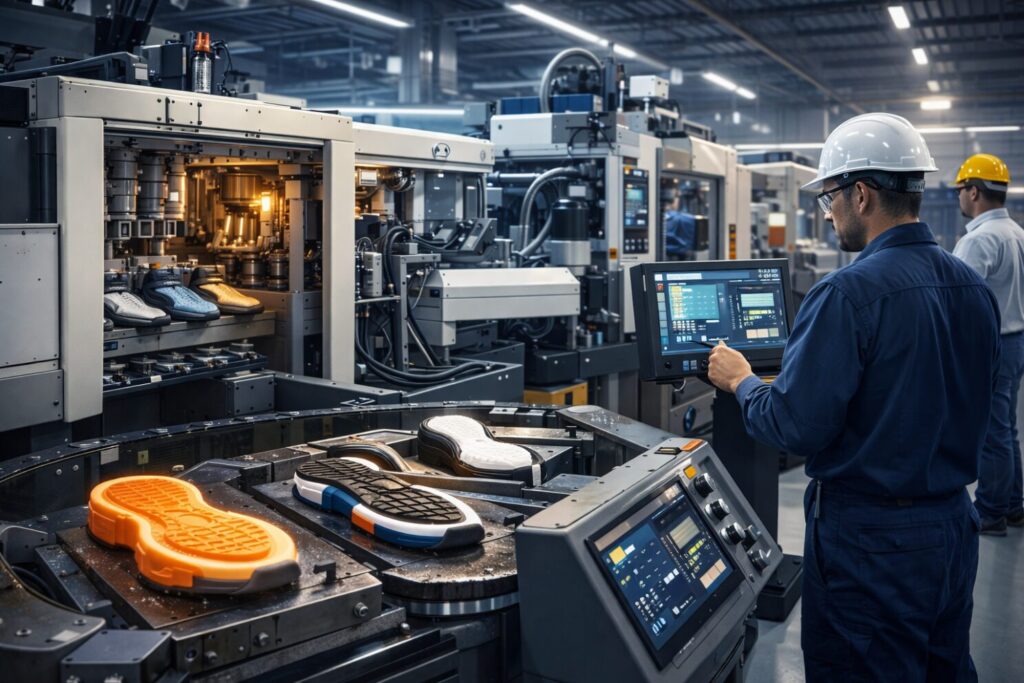
Why Machinery Investment Is Risk Management
In the footwear industry, machinery is not just equipment. It is part of your business risk strategy.
When you invest in a machine, you are not only buying steel and automation. You are buying:
- stability
- predictability
- scalability
That is why machine selection should always be based on long-term business performance, not short-term price comparison.
Why Technocrat Mouldings Focuses on ROI
Technocrat Mouldings has positioned itself around practical value, machine reliability, and support for real-world production. The content highlights its 33+ years of industry experience, 1550+ machines delivered, and 650+ clients.
That matters because manufacturers need more than a machine supplier. They need a partner that understands:
- production stability
- energy efficiency
- uptime
- service support
- long-term profitability
Final Thought
In sole manufacturing, your machine is not an expense. It is a revenue engine.
The right machine helps you reduce downtime, control energy cost, improve quality, and scale with confidence. Price matters, but machine life and uptime matter more.
Choose a machine partner with proven experience, transparent performance, and strong after-sales support.