
TPR Sole Material Explained: TPR vs PVC vs TPU vs PU — Which Sole Is Best? (2026)
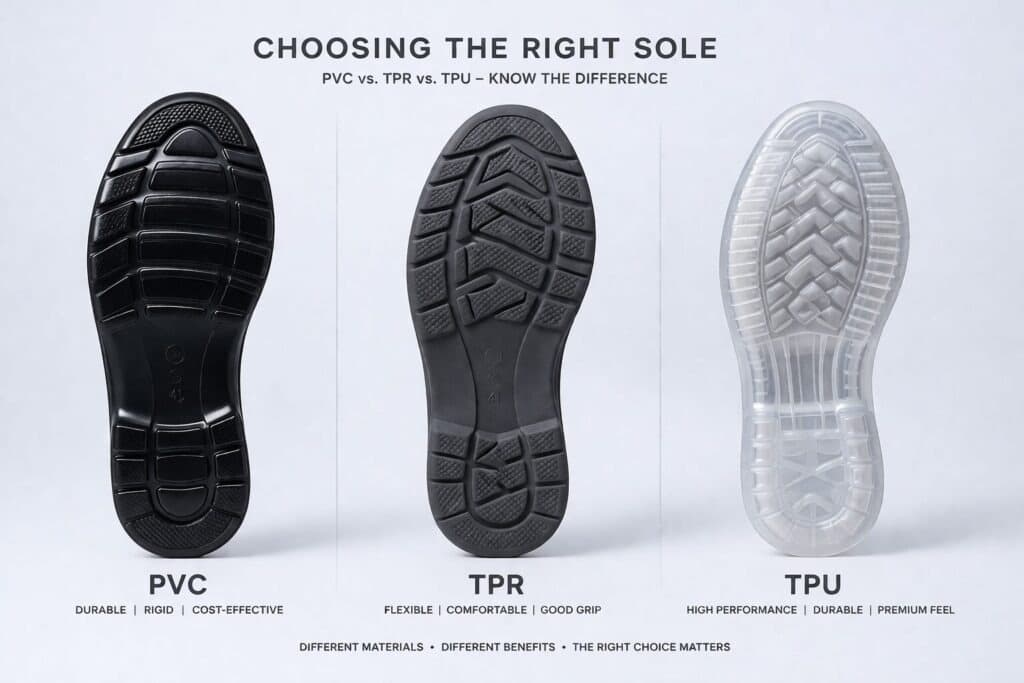
When it comes to crafting the perfect shoe, selecting the right sole material is crucial. Each type of sole has its own set of characteristics and advantages.
In this guide, we break down the differences between TPR, PVC, TPU and PU soles — plus airmix — helping you make an informed choice for your footwear manufacturing needs.
What Is TPR Sole Material? (TPR Sole Full Form)
TPR stands for Thermoplastic Rubber — a synthetic elastomer that blends the flexibility and grip of natural rubber with the easy, repeatable processing of a thermoplastic. That's the TPR sole material full form, and it's the reason TPR has become one of the most widely used sole materials in Indian footwear manufacturing.
Unlike natural rubber, which needs a slow vulcanisation (curing) process, TPR can be heated, injected into a mould, and cooled in a single fast cycle — the same injection-moulding process used for PVC and TPU. That makes it well suited to high-volume production on a single-colour sole moulding machine, running the same machine across TPR, PVC and TPU as your product mix changes.
TPR soles are lighter than PVC, offer good grip and flexibility, and are more economical than TPU — which is why TPR is the default choice for a wide range of everyday footwear, from casual shoes to industrial and safety footwear.
PVC (Polyvinyl Chloride) Sole
Made on a PVC sole making machine — see our range for output and specifications.
- Durability: Known for durability and resistance to wear and tear.
- Weight: Relatively heavier compared to other materials.
- Cost: A budget-conscious option for manufacturers.
- Water resistance: Highly water-resistant, ideal for rainy conditions.
- Traction: Provides excellent traction on various surfaces.
- Flexibility: Offers moderate flexibility.
TPR (Thermoplastic Rubber) Sole
Our Technica-100 TPR sole moulding machine is a workhorse choice for TPR production.
- Durability: Combines the durability of rubber with the ease of processing of plastic.
- Weight: Lighter than PVC, adding comfort to footwear.
- Cost: Economical and suitable for a wide range of shoe types.
- Traction: Offers good traction and grip.
- Flexibility: Flexible, providing comfort for the wearer.
- Environmentally friendlier: Often considered more environmentally friendly than PVC.
TPU (Thermoplastic Polyurethane) Sole
Our TC-100 triple-colour sole moulding machine also processes TPU for premium multi-colour soles.
- Durability: Highly durable, resistant to abrasion and oil.
- Weight: Lightweight, ensuring comfort for the wearer.
- Cost: Higher in cost, but offers premium quality.
- Traction: Provides excellent traction even in slippery conditions.
- Flexibility: Extremely flexible, adapting to the foot's movement.
- Eco-friendly: Recyclable and considered more environmentally friendly.
TPR vs PU Sole
TPR and PU (Polyurethane) are often compared because both aim to balance comfort, durability and cost — but they come from different production processes and suit different products.
TPR is injection-moulded directly into a sole shape on a sole moulding machine — a single fast cycle, easy to run across multiple colours and designs, and the more economical of the two. PU soles are produced by pouring a reactive liquid polyurethane into a mould, where it expands and cures — a process suited to single- and double-density cushioning, commonly used in safety shoes, sport shoes and premium comfort footwear.
In practical terms: TPR wins on cost and production speed for high-volume everyday footwear. PU wins on cushioning, weight (PU soles are typically lighter for the same volume) and comfort for premium or safety-focused products, but needs specialised PU pouring machines and a different raw-material handling setup than TPR.
If you're deciding between the two, the real question isn't which material is "better" — it's which one matches your target market, price point and comfort requirements. Tell us your footwear segment and monthly volume and we can help you compare the machine and material fit.
Airmix Sole Material
Airmix — also called air-blown — is a rotary PVC foaming process, not a separate raw material. During moulding, air is injected into the PVC compound on a rotary machine, producing a lighter, foamed sole with a slightly cushioned feel compared to solid PVC. It's the process behind the classic Indian hawai chappal sole, as well as many lightweight sandals and slippers.
Airmix soles run on a rotary air-blowing sole machine — a continuous, multi-station rotary line, not a manual cutting or pressing tool. Output scales with station count: a 20-24 station machine typically produces 130-180 pairs per hour, well beyond what a workshop-scale cutting setup can manage.
If you're a chappal, slipper or sandal manufacturer specifically evaluating this route, see our dedicated guide for chappal & slipper manufacturers — it covers machine selection, price ranges and a complete factory setup, and is explicit about what Technocrat does and doesn't manufacture in this space.
Which Sole Is Right for You?
- For durability: PVC and TPU soles are your best bet.
- For comfort and lightness: TPR and TPU soles are comfortable and lightweight.
- For cost-conscious production: PVC and TPR are economical.
- For eco-conscious choices: TPU is the most environmentally friendly.
- For premium cushioning: PU soles offer the lightest, most cushioned feel, suited to safety and sport footwear.
- For lightweight slipper/sandal soles: Airmix (air-blown PVC) offers a foamed, cushioned feel at high production volumes.
The choice between TPR, PVC, TPU and PU soles depends on your specific footwear needs, budget, and environmental considerations. Each type has its own unique benefits, so choose the material that best suits your market and customer preferences. Producing EVA soles or crocs-style footwear instead? See our EVA injection moulding machine range. Browse our full range of sole making machines to compare specifications across all materials.
Manufacturing slippers or chappals specifically? Our slipper making raw material guide: PVC vs EVA covers cost per pair, feel and which machine runs each material.
The sole is the foundation of any great shoe — choose wisely to step into success in the footwear industry.
Quick answers
TPR sole material kya hai?
TPR (Thermoplastic Rubber) is a synthetic elastomer that combines rubber-like flexibility and grip with the easy processing of a thermoplastic. It's injection-moulded into soles on a TPR sole moulding machine, and is one of the most widely used sole materials in Indian footwear manufacturing.
PVC sole material meaning in Hindi?
PVC (Polyvinyl Chloride) is a durable, water-resistant plastic sole material — heavier than TPR or TPU, but cost-effective and widely used for everyday footwear, industrial soles and rainy-season footwear across Indian factories.
Airmix sole kya hota hai?
Airmix (also called air-blown) refers to a rotary PVC foaming process that injects air into the PVC compound during moulding, producing a lighter, foamed sole — commonly used for slippers, sandals and hawai chappals. It runs on a rotary air-blowing sole machine, not a hand-cutting tool.