Sole Making Machine Buying Guide (2026)
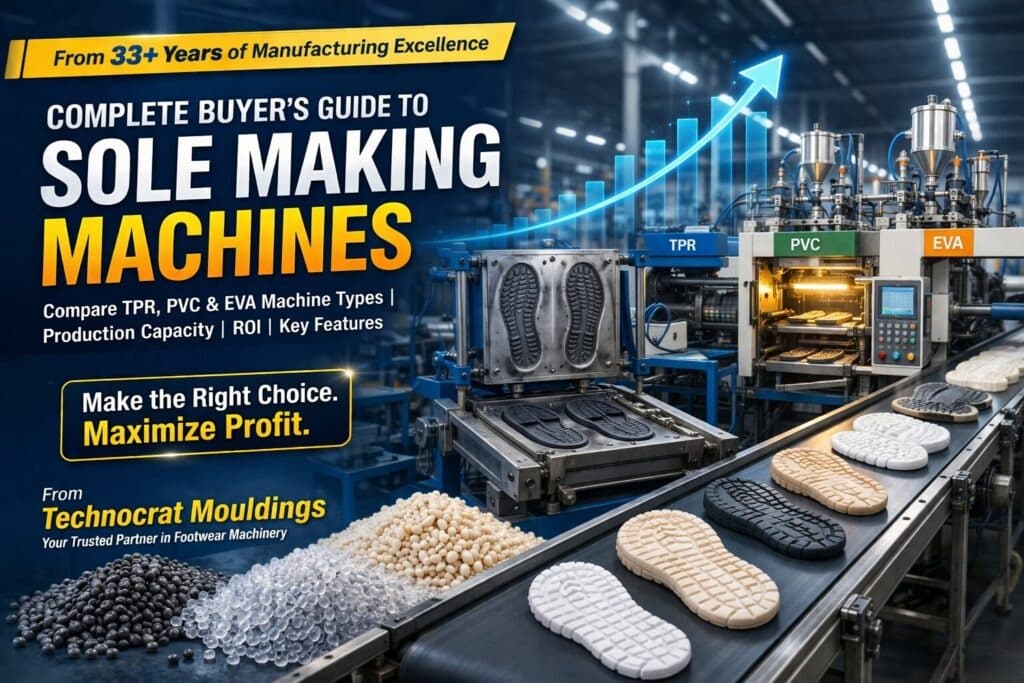
If you are planning to invest in a sole making machine, the decision directly impacts your production capacity, product quality, and long-term profitability.
This guide explains everything clearly — machine types, working process, price range, and how to select the right machine for your business.
What Is a Sole Making Machine?
A sole making machine is industrial equipment used to manufacture footwear soles using materials like PVC, TPR, TPU, or EVA. The process involves heating the material and injecting it into a mould under pressure. Once cooled, the finished sole is ready for assembly with shoe uppers.
Types of Sole Making Machines
Choosing the right type depends on your product category and target market.
Single Colour Sole Making Machine — for basic and high-volume production: slippers and sandals, industrial footwear, single-colour soles. Key advantage: simple operation and lower initial investment.
Double Colour Sole Making Machine — for higher-value footwear with better visual appeal: fashion footwear, sports soles, two-tone designs. Key advantage: higher selling price per pair due to design value.
Triple Colour Sole Making Machine — for premium footwear manufacturing: export-quality footwear, high-end designs, complex sole structures. Key advantage: maximum design flexibility and premium positioning.
EVA Sole Making Machine (Hot & Cold Press) — for lightweight and cushioning soles: sports shoes, comfort footwear, EVA-based products. Key advantage: lightweight, soft, and high-comfort output. For crocs-style clogs specifically, an EVA injection moulding machine is the injection-moulded alternative to press-type EVA.
Air-Blowing / Airmix Sole Machine — for lightweight and foam-based soles: bathroom slippers, lightweight sandals. Key advantage: reduced material density and lighter products. (Manufacturing chappals or slippers specifically? See our dedicated guide for chappal & slipper manufacturers.)
Shoe Last & Insole Machines — supporting machines for a complete footwear manufacturing setup, used for shoe shape formation (lasts) and cushion insoles.
Price Range of Sole Making Machines in India
The cost depends on machine type, production capacity, and specifications.
| Machine Type | Approx. Price Range |
|---|---|
| Single Colour | ₹7.5L – ₹25L |
| Double Colour | ₹15L – ₹35L |
| Triple Colour | ₹25L – ₹50L |
| EVA Machines | ₹20L – ₹45L |
Actual pricing varies based on configuration, automation level, and output capacity.
How to Choose the Right Sole Making Machine
This is where most buyers make mistakes. Focus on operational efficiency, not just purchase price.
- Material compatibility — ensure the machine supports your required material: PVC, TPR, TPU, or EVA.
- Production capacity — match machine output with your daily production target.
- Power consumption — power cost is a major long-term expense; energy-efficient machines significantly improve margins.
- Manpower requirement — machines requiring fewer operators reduce ongoing costs.
- Clamping force — higher clamping force allows more complex and larger sole designs.
- After-sales support — machine downtime directly affects revenue. Ensure spare parts availability, fast service response, and technical support.
- Total cost of ownership — don't evaluate on machine price alone. Consider electricity, labour, maintenance, and material wastage. This determines your cost per sole, which directly affects profitability. If you're also weighing an imported machine, see our imported vs Indian-made buyer's guide for how these factors compare across machine origins.
Common Buying Mistakes
- Choosing the lowest-price machine
- Ignoring energy consumption
- Not checking service support
- Overestimating production needs initially
- Buying complex machines without market demand
Why Machine Selection Matters
A well-chosen machine ensures consistent production quality, lower operating cost, faster return on investment, and the ability to scale production. A wrong decision leads to higher cost per pair, downtime, and limited growth.
Why Manufacturers Choose Technocrat Mouldings
Technocrat Mouldings focuses on practical manufacturing solutions designed for real production environments: proven machine reliability, energy-efficient performance, lower manpower requirement, consistent output quality, and long-term service support. With decades of experience and a large installed base, the focus remains on helping manufacturers build stable and scalable operations.
Conclusion
Buying a sole making machine is a strategic investment. The right choice improves production efficiency, reduces cost, and strengthens your market position. Start with a clear product plan, select a machine based on real production needs, and prioritize long-term performance over short-term savings.
If you are unsure which machine fits your requirement, a technical consultation can help you avoid costly mistakes and choose the right configuration from the start.