
How to Start a Footwear Manufacturing Business in India (2026 Guide)
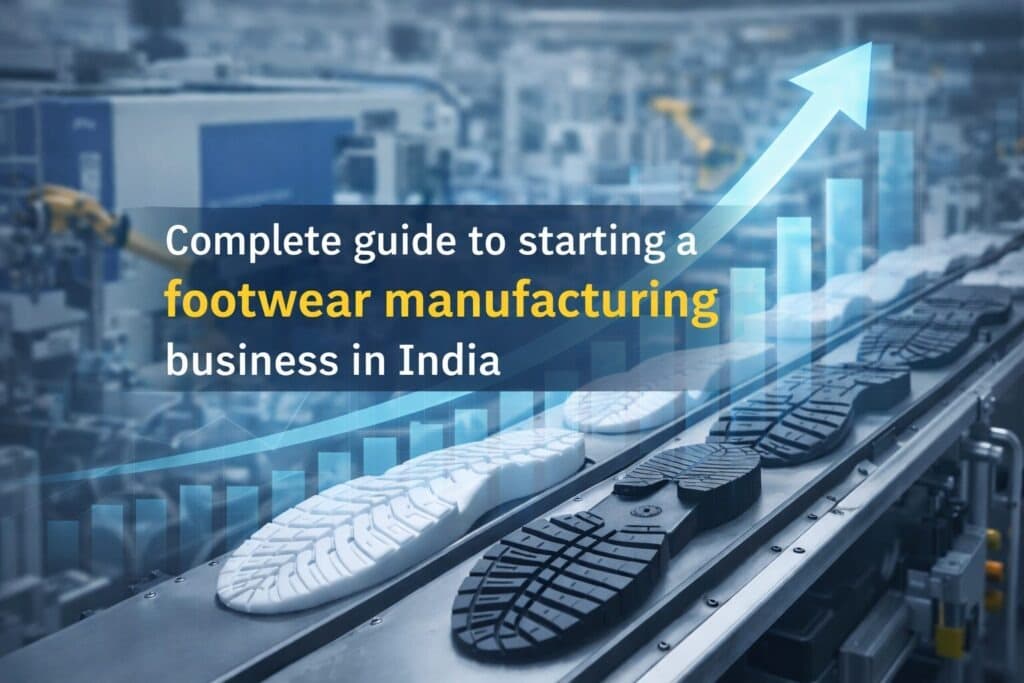
India's footwear industry is one of the strongest manufacturing markets in the country. Demand is growing in both domestic and export segments, which makes footwear production a practical business opportunity for new entrepreneurs as well as established manufacturers.
If you are planning to start a footwear manufacturing business in India, the first step is to choose the right product segment, the right machine, and a realistic production plan. This guide explains the complete process in simple terms.
Why Footwear Manufacturing Is a Good Business in 2026
Footwear manufacturing is attractive because the market is large, demand is consistent, and the business can start at a small scale. You do not need a very large factory at the beginning — a single machine setup can be enough to enter the market and grow step by step.
The main advantages are strong domestic demand, export opportunities, scope for small and medium-scale manufacturing, good margin potential with the right product mix, and easy scaling through additional machines and moulds.
Step 1: Decide Which Footwear Segment You Want to Make
Before investing in machinery, decide what type of footwear you want to manufacture — casual footwear such as slippers and sandals, formal footwear, sports footwear, or safety and industrial footwear.
For first-time business owners, casual footwear is usually the easiest segment to start with because demand is high and the entry cost is lower.
Step 2: Choose the Right Sole Making Machine
The machine you choose will directly affect your production capacity, product quality, power consumption, and profitability.
- Single Colour Sole Making Machine — best for basic slippers, sandals, and single-colour soles.
- Double Colour Sole Making Machine — suitable for fashion footwear and two-tone designs.
- Triple Colour Sole Making Machine — ideal for premium footwear and advanced design requirements.
- EVA Hot and Cold Rotary Press Machine — suitable for EVA soles and lightweight comfort footwear.
When selecting a machine, focus on material compatibility, production capacity, power consumption, the number of operators required, and service support and spare parts availability.
At Technocrat Mouldings, the goal is not just to supply a machine, but to help manufacturers choose the right model for their production need.
Step 3: Arrange Your Factory Space
You can begin with a compact setup — a large factory is not necessary in the initial stage. A typical single-machine setup needs 500 to 1,000 sq. ft. of space, a 3-phase power connection, proper ventilation, a raw material storage area, a finished goods storage area, and space for mould handling and packaging.
A location near footwear manufacturing clusters or raw material suppliers can reduce logistics cost and improve operational efficiency.
Step 4: Arrange Raw Materials and Moulds
Raw material selection depends on the type of sole or footwear you want to produce — TPR granules, PVC compound, EVA sheets, or TPU material, depending on the product requirement. You will also need moulds for the designs you plan to produce.
It is better to start with a small number of high-demand moulds instead of buying too many designs at once. Start with 3 to 5 popular designs first; once sales become stable, you can expand your mould collection gradually.
Step 5: Understand the Investment Required
The total investment depends on the machine type, factory setup, moulds, and working capital — covering the machine purchase, moulds, raw materials, electrical setup, factory setup, and working capital.
A small-scale footwear manufacturing unit can start with a practical investment range, depending on the machine and production plan. The actual return depends on output, selling price, material cost, and order volume.
Step 6: Complete the Legal Requirements
Before starting production, make sure your business is legally registered. Common requirements include business registration, GST registration, MSME/Udyam registration, pollution control compliance (where applicable), a trade license, and trademark registration for your brand name.
These formalities help you operate smoothly and build trust with buyers, distributors, and business partners.
Step 7: Start Production and Build Sales
Once the setup is ready, begin with a limited product range and focus on consistent quality rather than too many designs. Sales channels to explore include local wholesalers, retailers, B2B platforms, footwear brands, and export buyers.
A strong production setup, stable quality, and timely delivery are the main factors that help a footwear business grow.
Common Mistakes to Avoid
- Choosing a machine only on the basis of price
- Ignoring power consumption
- Buying too many moulds too early
- Starting without proper service support
- Neglecting quality control
- Expanding too fast without stable demand
A reliable machine and a disciplined production process usually create better long-term results than a low-cost but unstable setup.
Why Choose Technocrat Mouldings
Technocrat Mouldings has been working in footwear machinery for decades and supports manufacturers with practical machine solutions for sole making, insole making, shoe last making, and paver mould production — backed by deep industry experience and 650+ clients.
For manufacturers, the real value lies in reliable machine performance, energy-efficient operation, lower manpower requirement, practical production output, and support for business growth.
Conclusion
Starting a footwear manufacturing business in India is a realistic and profitable opportunity when done with the right planning. The most important decisions are choosing the right footwear segment, selecting the correct machine, and keeping the setup simple at the beginning.
If you begin with a clear product plan, a dependable machine, and a focus on quality, your business will have a strong foundation for long-term growth.